POND, MISSOURI · ROUTE 66
BUILT FOR THE ROAD.
Before the interstates. Before the modern motel.
There was Big Chief.

EST. 1929


1928 - 1929
SOMETHING NEW
IN HOTELS.
In the late 1920s, America was discovering the open road. Automobile travel was transforming the way people moved across the country, and the newly designated Route 66 carried a growing stream of travelers through the small Missouri community of Pond.
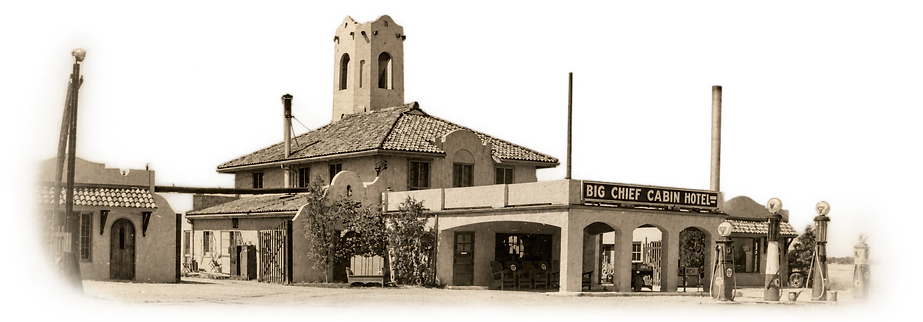
Along Manchester Road, an ambitious new destination was taking shape. The Big Chief Highway Hotel brought together lodging, dining, gasoline and recreation in a single roadside complex built for the automobile age.
With 62 tourist cabins, each with its own private garage, Big Chief was among the largest tourist courts in Missouri. Travelers could fill the tank, enjoy a steak dinner, spend the night, and continue west the next morning.
It was a remarkably modern idea for its time.
A destination built for the road ahead.

Big Chief Highway Hotel No. 1 · Pond, Missouri · c. 1928–29.
62 CABINS
$1.50
75¢
each with a
private garage.
per night
steak dinner


DINNER · DANCING · GASOLINE · LODGING
THE BIG CHIEF
HIGHWAY HOTEL

MORE THAN A PLACE
TO SPEND THE NIGHT.
Big Chief was designed to offer travelers something far beyond a bed for the night. Guests could dine in an elegant restaurant, refuel their automobiles, purchase supplies and spend an evening enjoying themselves before returning to the road.
The restaurant became a destination in its own right. Its Mission Revival architecture, arched openings and terra-cotta roof gave Big Chief an appearance unlike the simple roadside stops appearing across much of the country.
Inside, the dining room wasn't always just a dining room. Tables could be moved aside for dancing, and Big Chief became a gathering place for travelers and local residents alike.
For a while, the highway didn't simply pass Big Chief. It stopped here.
1932
THE ROAD MOVED.
BIG CHIEF STAYED.
_____________________
Big Chief was built for Route 66.
Then Route 66 moved.
In 1932, the highway was realigned away from Manchester Road and Pond, taking much of the stream of cross-country traffic with it.
Big Chief remained.
1933 - 1940s
A DIFFERENT KIND
OF ROADSIDE STOP.
Route 66 had moved, but Big Chief continued to change with the world around it.
1933
PROHIBITION ENDS
World War II brought an entirely different role for the Big Chief property. The tourist cabins that had once welcomed cross-country motorists were used as much-needed housing for employees of the nearby Weldon Spring Ordnance Works.
After the war, that transition to longer-term housing continued, with cabins rented to workers at the Weldon Spring uranium processing plant. What had begun as lodging for the automobile traveler had adapted once again to meet the needs of a changing community.
|
·
|
|
|
|
|
|
|
|
·
|
|
|
|
|
|
|
|
|
When Prohibition ended in 1933, Big Chief added bar service to its already established restaurant and social scene. Though Route 66 had been realigned away from Pond, Big Chief continued to draw local guests for dances, meetings and gatherings.
The highway traffic had changed. Big Chief was becoming a destination for the community around it.
1940s
A NEW PURPOSE
c. 1950
THE ACETO YEARS
Marco and Rose Aceto arrived at Big Chief with plans to bring the restaurant back to life.
Around 1950, St. Louis restaurateurs Marco and Rose Aceto purchased Big Chief with hopes of reopening the restaurant.
Those plans didn't happen immediately. Unable to secure the necessary permit, the Acetos made the former restaurant building their home while the remaining cabins continued to serve as long-term rentals.
Nearly three decades after Big Chief first welcomed travelers along Route 66, the property was entering a very different chapter.
c. 1959
THE TAVERN OPENS
Around 1959, the Acetos finally opened a tavern in the former Big Chief restaurant building. The grand tourist complex of the late 1920s was disappearing, but the building at its center continued to find a reason to remain.
Around this same period, Big Chief's distinctive tower, one of the defining features of the original Highway Hotel, was removed. The sprawling tourist complex of the 1920s was steadily disappearing, and the building at its center was taking on a new identity.
1960s-1970s
BIG CHIEF TAVERN
By the 1960s, the name Big Chief Tavern was firmly established. Surviving licenses and permits document Rose C. Aceto operating the tavern on Manchester Road through the late 1960s and into the 1970s.
The roadside hotel was gone, but Big Chief remained a place to gather, eat and drink—a role the building had served in one form or another for decades.
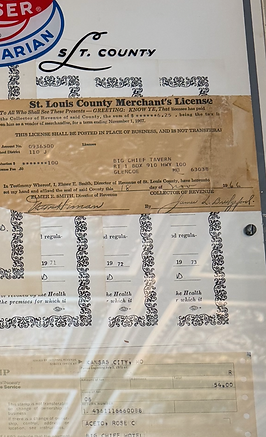
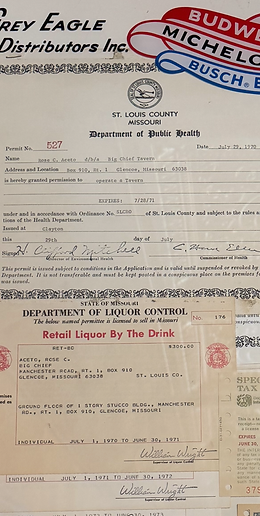
Various health and liquor licenses from the late 1960s to 1970s
1970s
THE CABINS
DISAPPEAR.
For decades, the original tourist cabins remained behind the restaurant—a fading reminder of the sprawling Highway Hotel that had once welcomed travelers along Route 66.
By the 1970s, time had taken its toll. The aging cabins had deteriorated beyond their former purpose, and the remaining structures were eventually demolished.
Of the original Big Chief Highway Hotel complex, the restaurant remained.

The remaining tourist cabins, c. 1976. Demolition followed shortly after.

A closer view of the deteriorating tourist cabins shortly before demolition.
62 CABINS.
ONE RESTAURANT
REMAINED.


IN THE YEARS THAT FOLLOWED, THE SURVIVING RESTAURANT BUILDING PASSED THROUGH SEVERAL USES, BUT THE STRUCTURE THAT ONCE WELCOMED ROUTE 66 TRAVELERS REMAINED.
1995
THE RESTAURANT
RETURNS

______
Big Chief
Dakota Grill
In the early 1990s, the historic restaurant building was restored, and in 1995 it reopened as the Big Chief Dakota Grill.
The restoration brought new life to a landmark that had survived the decline of Route 66, decades of change, and the demolition of the original tourist cabins.
Once again, Big Chief welcomed guests not as a sprawling highway hotel, but as a restaurant, continuing a tradition that had begun more than sixty-five years earlier.
Big Chief Dakota Grill shortly after reopening, c. 1995.
A new chapter had begun, but the spirit of Big Chief lived on.
2003
A PLACE WORTH
PRESERVING

NATIONAL REGISTER OF HISTORIC PLACES
On April 2, 2003, the Big Chief Restaurant was officially listed in the National Register of Historic Places.
The designation recognized the historical significance of the property and formally documented Big Chief's place in the story of America's early automobile era.
What had begun as an ambitious roadside hotel more than seven decades earlier had become something increasingly rare: a surviving piece of the world that Route 66 helped create.
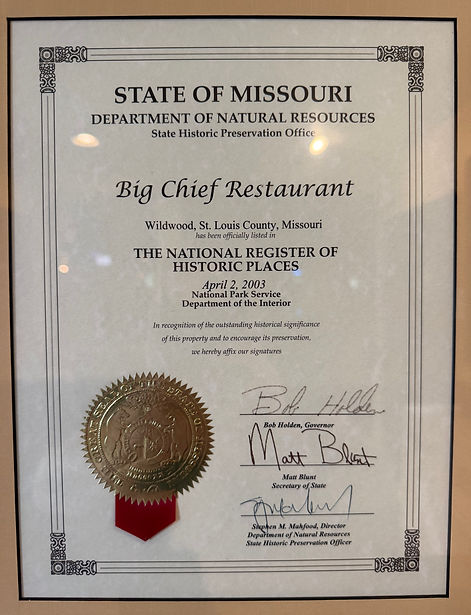
National Register of Historic Places certificate · April 2, 2003
2012
A NEW ERA
BEGINS

Big Chief Roadhouse · June 2012
BIG CHIEF ROADHOUSE
In March 2012, Big Chief entered another
chapter. New ownership closed the restaurant for an extensive renovation, updating the
building while preserving its historic character.
On June 11, the doors opened again—this time
as Big Chief Roadhouse.
The kitchen was expanded, the interior
remodeled and a new horseshoe bar installed.
But the purpose of the building remained
remarkably familiar: a place along the old
road where people could gather around food and drink.

Inside the newly remodeled restaurant · 2012

The buffalo retained during the 2012 renovation.
The name was new.
The reason for stopping wasn't.
